A credible source has a named author, checkable evidence and a clear purpose you can verify elsewhere.
Have a headline to test? Try the Headline Lab.
Headline Lab
Paste any headline below. Headline Lab flags curiosity gaps, loaded words, ALL CAPS and other clickbait tricks, highlights them in the text and suggests a calmer way to say it.
Waiting for a headline
Type or paste a headline to see its score from 0 (straight) to 100 (pure clickbait).
Results appear here once you enter a headline. Nothing leaves your browser.
What makes a source credible
Key points for this section.
A credible source names a real author or organisation, states where its information came from, and can be checked against other sources. None of these alone proves a claim true, but their absence is a fast way to spot a weak one.
- A named author or organisation that can be looked up, not an anonymous account or an unsigned post.
- Evidence that links back to an original document, dataset or on-the-record quote.
- A publish date and, where the content has changed, an update date.
Credibility is not the same as agreement: a source can be credible and still be wrong on a specific detail, and a source can share a view a reader likes while still skipping every check above. The checks below are about how a claim is supported, not about whether it is popular.
Checks for a website
Table rows are listed below.
| Sign | How to check | Note |
|---|---|---|
| Named author | Search the name | Look for a record of other published work |
| Citations | Open the links | Check whether they actually support the claim |
| About page | Read who runs the site | A real organisation lists a real address or registration |
| Corrections | Search “site:domain correction” | A record of fixing mistakes is a credibility signal, not a weakness |
These checks take a minute or two per source; running two or three of them together is enough to separate most credible reporting from an unverified post repeating a rumor.
A site’s own domain record is a smaller, supporting signal: a long-registered domain with a stable name is not proof of credibility on its own, but a domain created days ago and already publishing urgent breaking-news claims is worth a second look, especially paired with no named author.
Three quick red flags, on their own or together, are worth noticing before sharing a claim:
- The only source cited is another unsourced post, not an original document or on-the-record statement.
- The author byline is a generic handle or missing entirely, with no About page explaining who runs the site.
- The language states a developing situation as fully confirmed (“proof”, “confirmed”) before named officials or documents are cited.
Credible vs non-credible examples
True facts about the site, updated when they change.
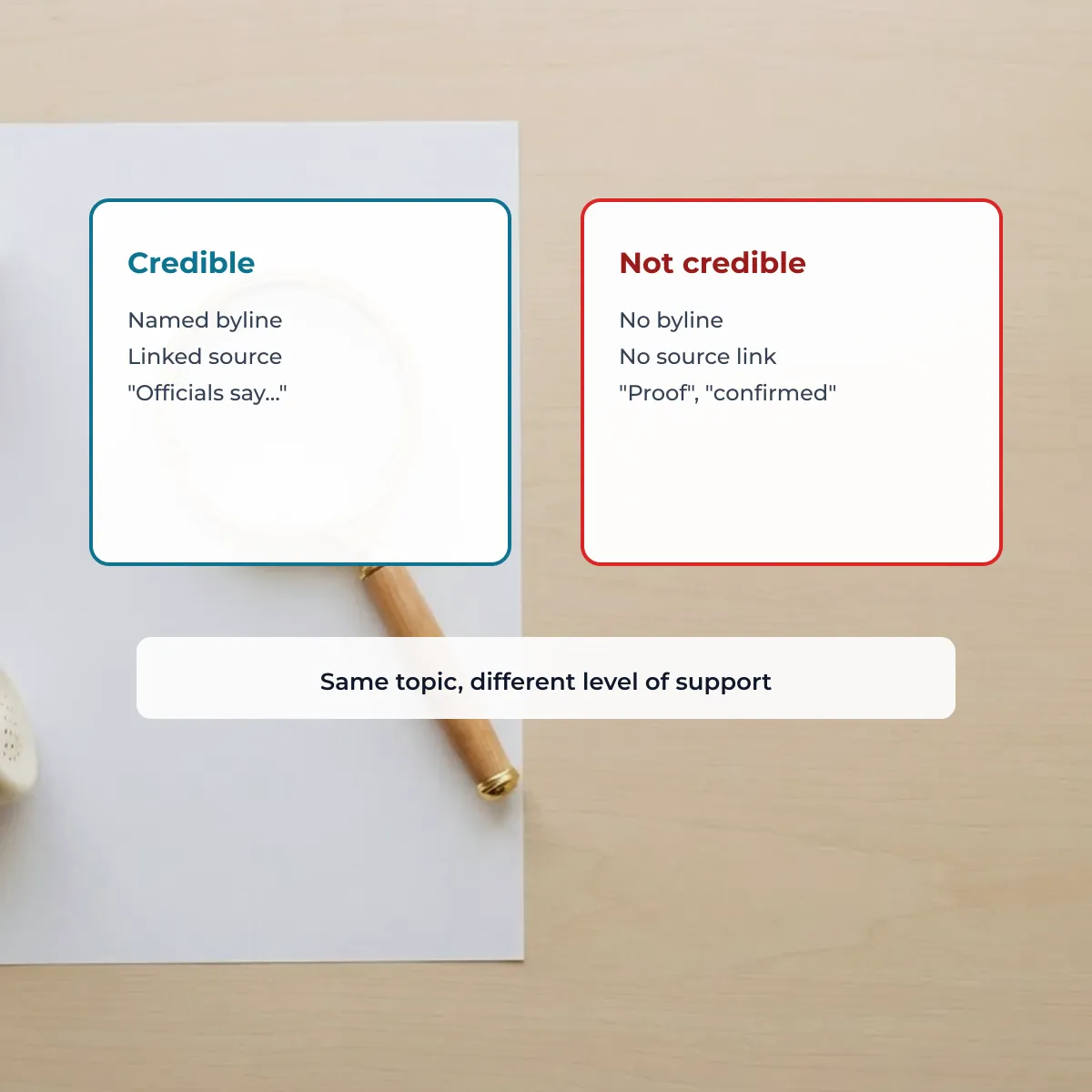
A credible news report names its reporter, links its source documents, and separates what is confirmed from what is still being reported. A non-credible post typically skips all three: no byline, no link to the original claim, and language that states a rumor as settled fact. Neither label depends on whether a story is positive or negative — a flattering claim with no named source is exactly as unverified as a critical one.
| Element | Credible example | Non-credible example |
|---|---|---|
| Byline | Named reporter, searchable history | No name, or a generic account handle |
| Sourcing | Links to a document, record or on-the-record quote | Links only to another unsourced post, or no link |
| Certainty language | “Officials say”, “according to the report” | “Proof”, “confirmed” before any document is cited |
These checks help but do not prove a story true or false — confirm with the original source.
Test a sample headline above with the Theary News Lab headline checker, or see the mechanics of clickbait in what clickbait means.
Was this page helpful?
One tap tells us what to explain better.
Thanks for your feedback!