Clickbait is a headline or thumbnail written to earn a click by hiding or inflating what the story says.
Have a headline to test? Try the Headline Lab.
Headline Lab
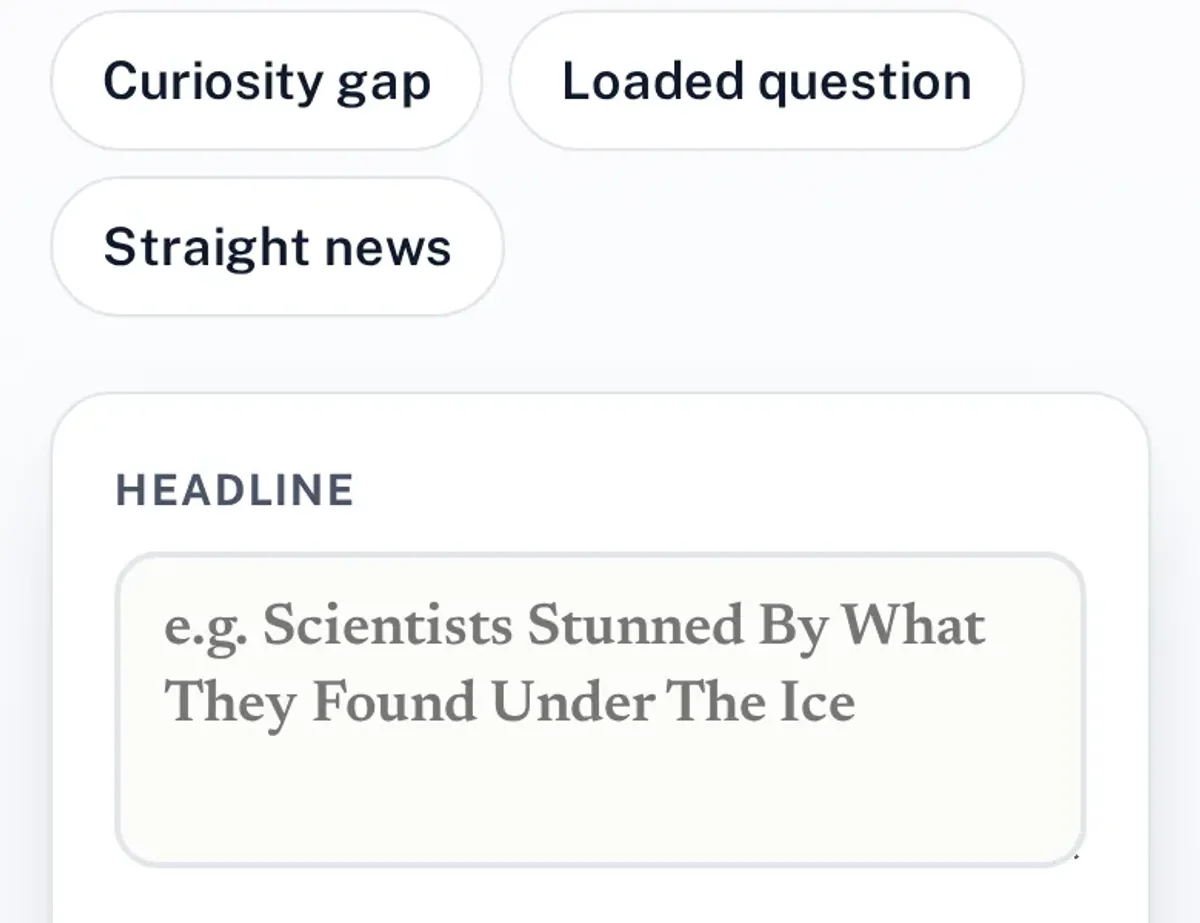
Paste any headline below. Headline Lab flags curiosity gaps, loaded words, ALL CAPS and other clickbait tricks, highlights them in the text and suggests a calmer way to say it.
Waiting for a headline
Type or paste a headline to see its score from 0 (straight) to 100 (pure clickbait).
Results appear here once you enter a headline. Nothing leaves your browser.
How clickbait works
Key points for this section.
Most clickbait headlines lean on one mechanic: the curiosity gap. The headline names a topic but withholds the actual fact (“what happened next”, “the reason why”), so a reader has to click to close the gap. Journalism researchers and dictionaries describe clickbait the same way — Merriam-Webster defines it as content designed “to make readers want to click on a hyperlink”, especially when the link’s text is “unreliable or questionable”.
A related idea, often called Betteridge’s law of headlines, holds that a headline phrased as a yes/no question can usually be answered “no” — because if the answer were a clear “yes”, the writer would have stated it directly. The Headline Lab above flags question headlines for this reason.
- Withholds the key fact (name, number, outcome) that would let a reader decide whether to click.
- Uses a vague pronoun (“this”, “what he said”) instead of naming the subject.
- Adds urgency or emotion (ALL CAPS, exclamation marks, words like “shocking”) on top of a thin fact.
The pull of a curiosity gap is not accidental: psychologists studying curiosity describe it as a reaction to a gap between what someone already knows and what they want to know, and closing that gap feels rewarding even when the fact behind it turns out to be small. A clickbait headline manufactures that gap on purpose, by naming a topic without the detail that would close it.
Why it spreads
Table rows are listed below.
| Trick | How it works | Warning sign |
|---|---|---|
| Curiosity gap | Withholds the point of the story | Vague pronoun (“this”, “what happened”) |
| Exaggeration | Inflates the stakes of an ordinary event | Words like “shocking”, “stunned”, “slams” |
| False urgency | Implies a closing window to act or react | “Before it’s too late”, stacked punctuation |
| Listicle hook | Promises a count without the content | “7 things”, “secrets”, “tricks” |
These patterns spread because each one adds a small nudge to click before a reader has seen the actual fact; stacking two or three tricks in one headline raises the Headline Lab score sharply, which is why the tool scores combinations rather than single words.
The same tricks show up in a few repeated formats across platforms:
- Numbered list headlines (“9 things you didn’t know about…”) that promise a count without previewing the content.
- Reaction headlines built around someone’s emotion (“fans are furious”) instead of the event that caused it.
- Before/after or reveal thumbnails paired with a headline that names neither the before nor the after.
How to respond to it
Use this as a check, then confirm with the original source.
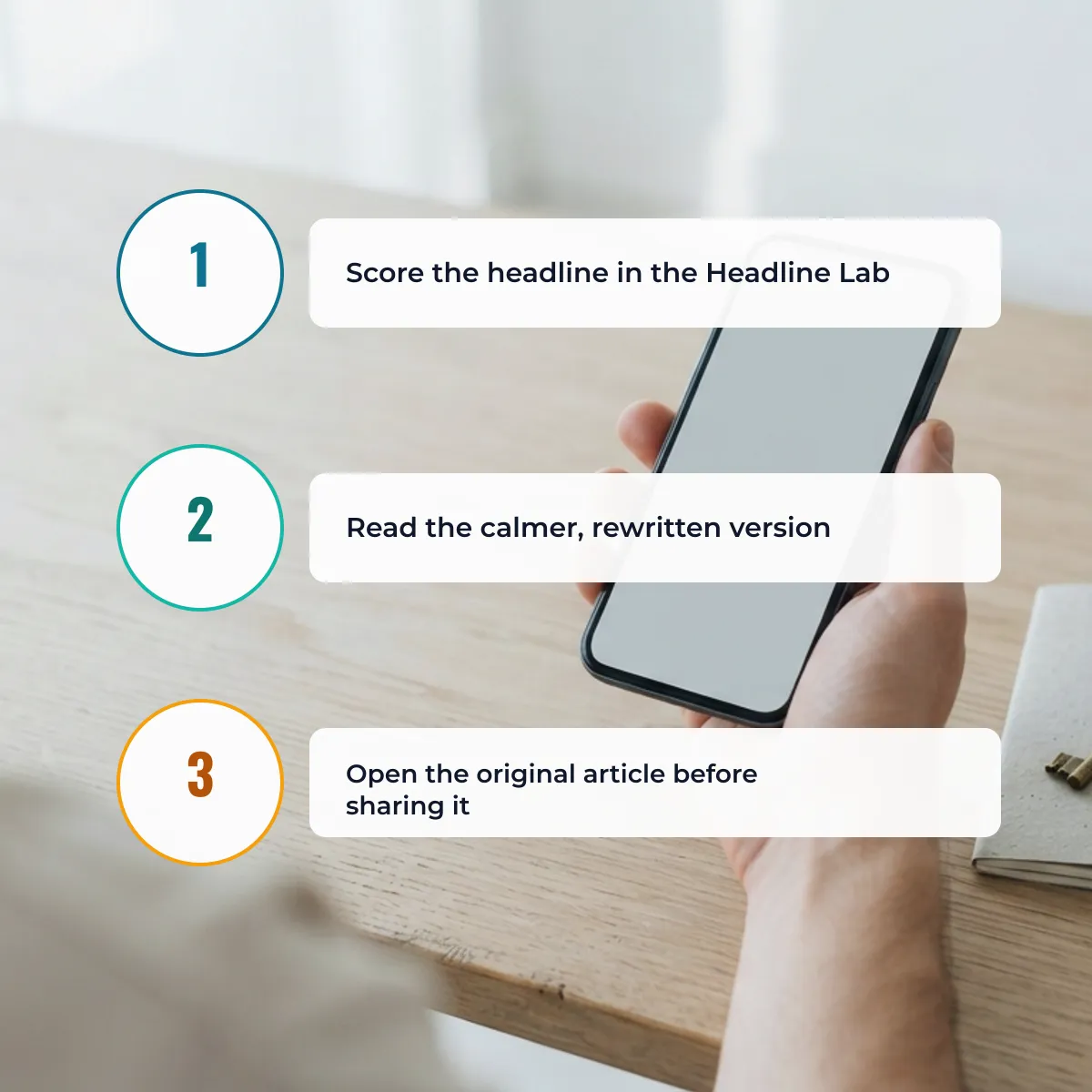
Reading past the headline is the simplest response: the Headline Lab rewrites a flagged headline into a calmer version that names the fact directly, which is a fast way to see what a curiosity-gap headline was hiding. Checking the outlet and date, and opening the actual article before sharing it, catches most of the rest.
A few more checks help on platforms where the headline and the article are shown separately, such as a social feed or a video thumbnail:
- Open the article and read the first two paragraphs before reacting to the headline alone.
- Look for the same story on a second outlet; if only one source uses the dramatic framing, that framing is likely the bait, not the news.
- Check the publish date — a recycled old story reposted with a new, more urgent headline is a common clickbait pattern.
These checks help but do not prove a story true or false — confirm with the original source.
None of these checks require special tools: a reverse image search, the outlet’s own correction log, or a quick search for the same claim on a wire service (AP, Reuters) will usually confirm or deflate an exaggerated headline within a minute or two.
Theary News Lab’s full guide list continues with the Headline Lab and read meter.
Was this page helpful?
One tap tells us what to explain better.
Thanks for your feedback!