Media literacy is the ability to access, question and evaluate what the media publishes before you trust or share it. Have a headline to test? Try the Theary News Lab headline checker.
Core media literacy skills
Key points for this section: check who published a story, what evidence backs it, whether the headline matches the body, and whether other outlets report the same facts before sharing it further.
- Source check. Look for a named publisher, an about page and a way to contact the newsroom; an outlet that hides all three is harder to hold accountable for errors.
- Evidence check. A claim backed by a document, a dataset or a named official is stronger than one backed only by “sources say”; follow the link before accepting the claim.
- Headline-to-body check. Headlines compress a story into a few words, so some gap between headline and detail is normal; read for whether the body actually supports what the headline implies.
- Cross-reference check. A fact reported by only one outlet, with no one else covering it days later, is worth treating as unconfirmed rather than settled.
- Author check. A byline with a track record on the topic carries different weight than an unsigned post; look for other work by the same author.
- Date check. An undated article, or one reporting on an event from years earlier without saying so, can pass as current news when it is not.
No single check settles a story on its own; a byline without a traceable source, or a strong claim with no linked evidence, is a prompt to slow down rather than a final verdict. Reading for these signals together, rather than any one in isolation, is what separates a quick skim from an actual review of what a story is claiming and why.
Examples in daily reading
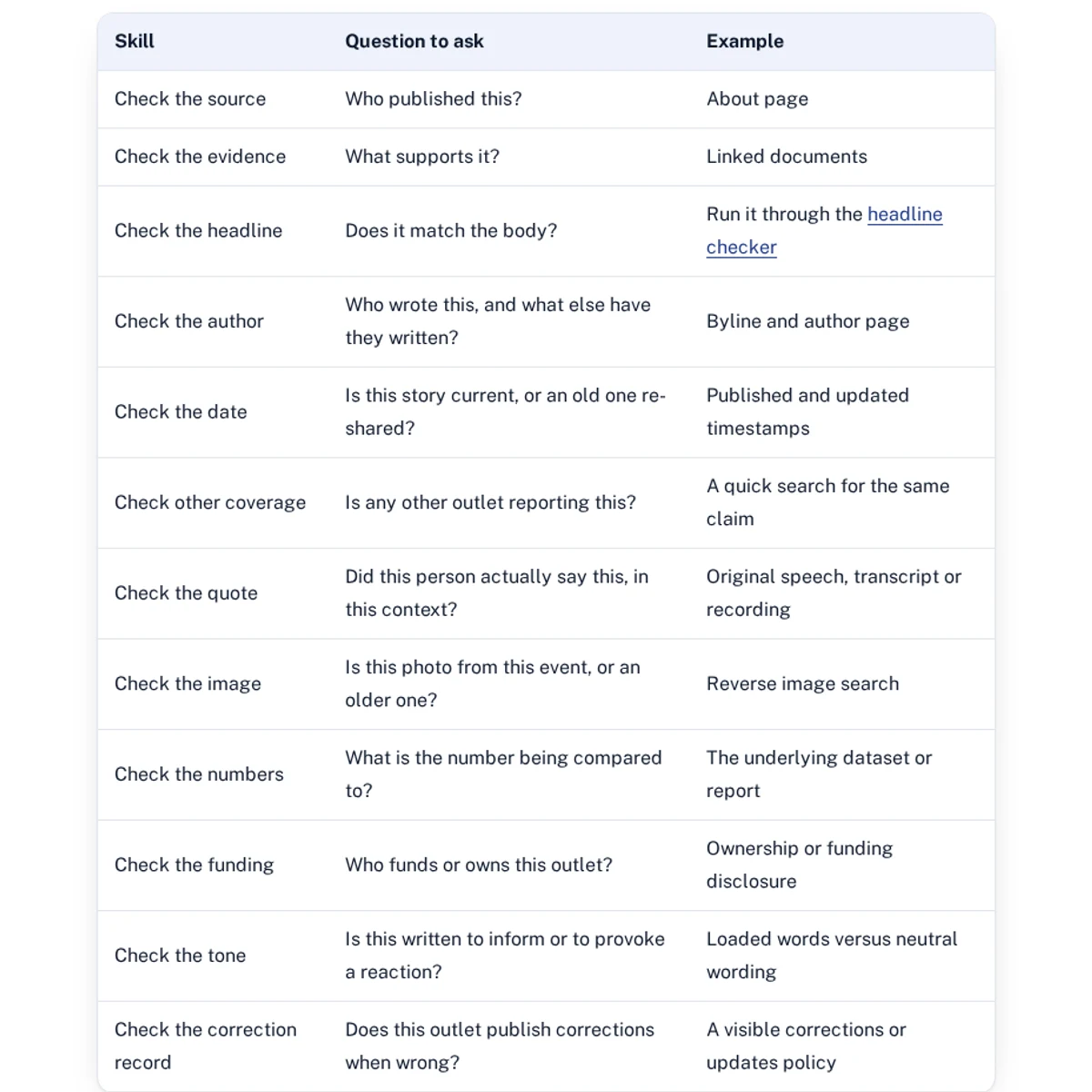
Table rows are listed below. Each row pairs a skill with the question it answers and a concrete place to look for the answer, so the list works as a quick reference while reading rather than a set of abstract rules.
| Skill | Question to ask | Example |
|---|---|---|
| Check the source | Who published this? | About page |
| Check the evidence | What supports it? | Linked documents |
| Check the headline | Does it match the body? | Run it through the headline checker |
| Check the author | Who wrote this, and what else have they written? | Byline and author page |
| Check the date | Is this story current, or an old one re-shared? | Published and updated timestamps |
| Check other coverage | Is any other outlet reporting this? | A quick search for the same claim |
| Check the quote | Did this person actually say this, in this context? | Original speech, transcript or recording |
| Check the image | Is this photo from this event, or an older one? | Reverse image search |
| Check the numbers | What is the number being compared to? | The underlying dataset or report |
| Check the funding | Who funds or owns this outlet? | Ownership or funding disclosure |
| Check the tone | Is this written to inform or to provoke a reaction? | Loaded words versus neutral wording |
| Check the correction record | Does this outlet publish corrections when wrong? | A visible corrections or updates policy |
Practice with a real headline
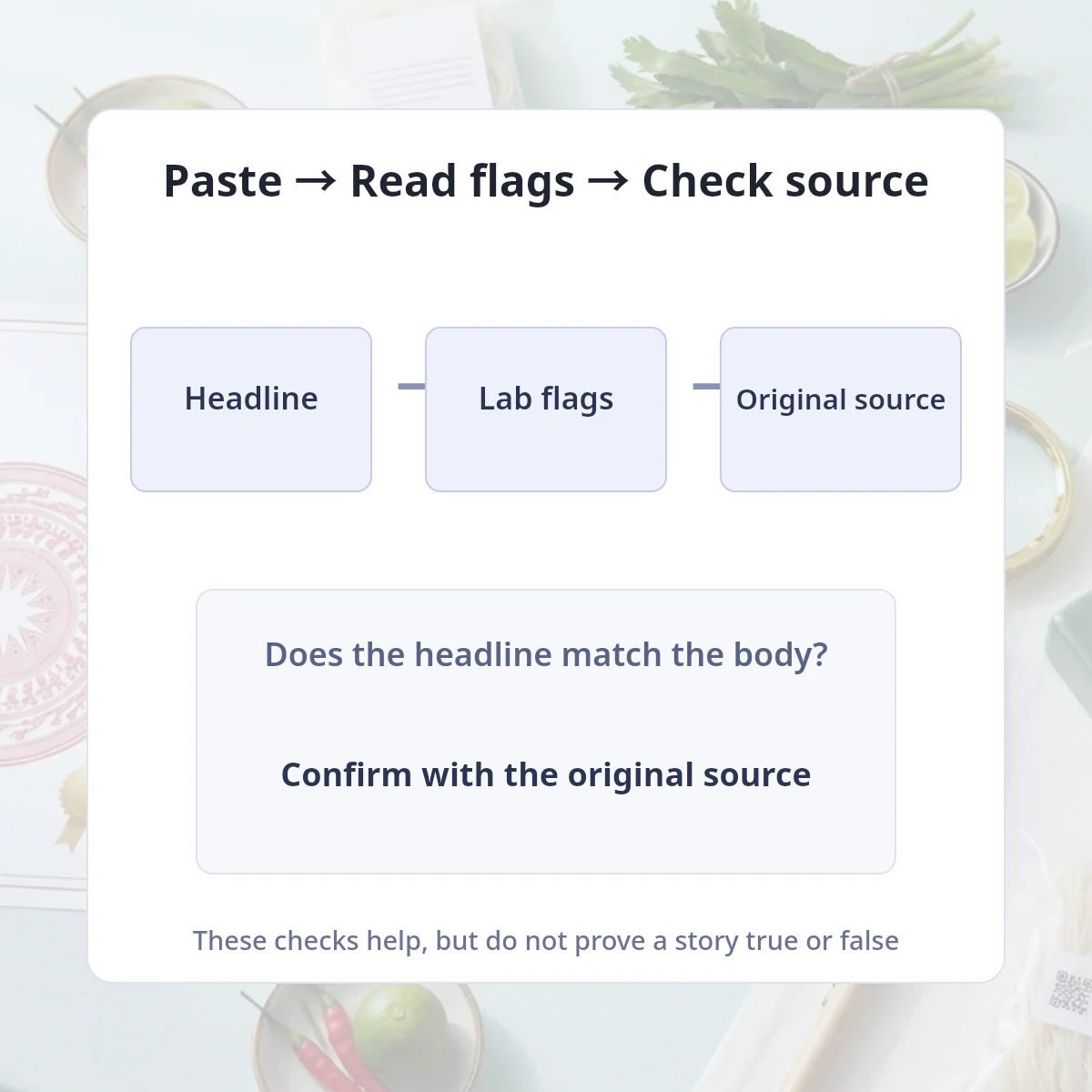
Use this as a check, then confirm with the original source: paste a real headline into the Theary News Lab headline checker, read what it flags, and look up the story’s credible sources before sharing.
- Paste the headline into the checker and read which words it flags.
- Open the article and compare the headline against the first few paragraphs.
- Follow at least one linked source or document named in the story.
- Check whether another outlet is reporting the same facts.
- Decide whether to share, and if the claim is uncertain, say so when you share it.
The same five steps work for a headline forwarded in a chat, a post seen while scrolling, or a story read on the publisher’s own site; what changes is how many of the links and sources are easy to reach. When a story offers no author, no date and no link to follow, that absence is itself useful information about how much weight to give it.
These checks help but do not prove a story true or false; confirm with the original source.
None of these skills require special tools beyond a search engine and a few minutes of reading; the harder part is pausing before sharing. Theary News Lab keeps its reference tables and headline checker free to use, with every sample marked as a sample rather than a real story. The goal is not to distrust every headline by default, but to build a habit of checking before reacting, so that the stories worth sharing are the ones that hold up once you look.
Was this page helpful?
One tap tells us what to explain better.
Thanks for your feedback!